Vice President Tareck El Aissami announced Thursday night via
his Twitter account that pharmacist Luis Lopez was replacing Caporale at Maduro's request.
Caporale had been on the job since January. The data from her office showed that confirmed malaria cases in 2016 stood at 240,000, a 76% increase over the previous year.
Maternal -- or pregnancy-related -- deaths rose 66%, to 756. Last year, 11,466 infants died, a 30% increase.
The new health minister, Lopez, has been the deputy minister of hospitals for the national government and secretary of health for the Venezuelan state of Aragua, according to state-run news agency AVN.
Crumbling health care system
The staggering increases illustrate
how badly Venezuela lacks basic medicine, equipment and supplies to treat even the simplest of injuries.
Venezuelans say they must treat themselves at public hospitals.
"If you need to have an operation, nowadays, you must bring your own medicines to the hospital," says Eugenia Morin, a 59-year-old housewife who protested against the government last week. "There are no supplies to attend the most basic emergencies."
The country was already facing a shortage of more than 80% of medicines that doctors need as of last June, according to
statistics from the Venezuelan Pharmaceutical Federation.
And it's not just medicine. Patients are responsible for any material needed to treat them: needles, gauze pads, saline solution. Patients who can get the money together to buy these items become targets of crime -- hospital rooms are not safe from thieves looking to sell medication on the black market, or fellow patients in desperation.
And more than 13,000 doctors -- about 20% of Venezuela's medical workforce, have left the country in recent years as the health sector collapsed.
Lack of food compounds health shortages
The health figures represent only one of many crises facing Venezuela, once the richest nation in Latin America and home to the world's largest oil reserves.
Venezuelans are suffering from severe food shortages.
According to a national polling firm, the average Venezuelan living in extreme poverty last year lost nearly 19 pounds due to lack of food and skipped meals.
Supermarket shelves are often empty. Skyrocketing inflation -- set to go up 720% this year, according to the International Monetary Fund -- makes whatever food that's available
too expensive for many to buy.
In the face of these shortages, Venezuela has descended further into political chaos.
See the latest news and share your comments with CNN Health on Facebook and Twitter.
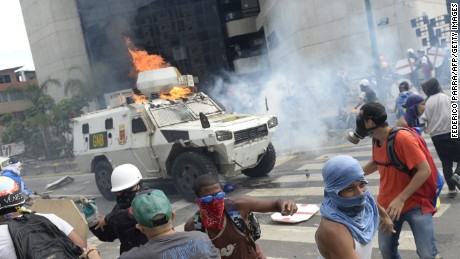
Protests have
raged across the country since the Supreme Court -- stacked with the President's loyalists --
attempted to take away legislative power from the opposition-led National Assembly in late March.
Protesters have been met by oppressive police tactics, including
one case of a tank rolling over a young man. Thirty-eight Venezuelans have died since the unrest began.


Comments