What was significant about the Brady amendment passed two weeks ago is that it managed to unite the Conservative party behind a Brexit proposition. Only eight Tories voted against.
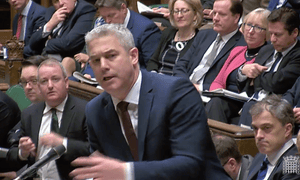
But managing to come up with a Brexit stance acceptable to remainers and leavers in the party is much harder than it looks and, in his speech opening the debate, Stephen Barclay, the Brexit secretary, struggled considerably. He arrived armed with a no-deal assurance intended to go down well with the hardliners in the European Research Group, and some conciliatory language about the so-called Malthouse compromise, which is viewed as the holy grail by some Brexiters. But quite quickly it became apparent that he was not giving them quite as much as they wanted. And, in the second half of his speech, after he tacked towards leave, remainers in the party started standing up in the chamber to complain.
It is not clear yet what will happen in the vote on the main motion, but Nikki da Costa, a former director of legislative affairs at Number 10, concluded after hearing Barclay’s speech that the government was in real trouble.
Nikki da Costa (@nmdacosta)
Am wincing listening to opening remarks. I fear response to interventions has probably aggravated - whatever the drafting in the speaking notes, the delivery makes such a difference. I think we are heading towards quite a significant defeat. V clumsy handling of last few days. https://t.co/ioEJL0TOOk
February 14, 2019
Sir Keir Starmer, Barclay’s shadow, was responding for Labour and the opening of his speech, which focused on the folly of Theresa May thinking that she will be able to achieve changes to the Brexit deal now which have eluded her for weeks, was excellent. But Labour is also a party deeply divided over Brexit and towards the end he faced strong criticism from some Labour pro-Europeans who want the party to commit to a second referendum now. He was unable to give them the assurances they wanted to hear, just as he also struggled to explain why Labour was at once accepting the need for a backstop while having reservations about it.
Here are the main points.
- Barclay insisted that the government was willing to leave the EU on 29 March without a deal. Earlier this week Olly Robbins, Theresa May’s chief Brexit adviser, suggested in a conversation overheard in Brussels, that this would not be an option. Barclay was responding to a question from the Brexiter David Davis who asked for an assurance that the UK would still leave on 29 March in the event of May not getting an acceptable deal. Barclay replied:
I’m very happy to give [Davis] that assurance.
This seemed designed to mollify the ERG Brexiters who do not want to back the main government motion because it implicitly endorses the vote two weeks ago ruling out no deal. Davis seemed happy with what he heard.
David Davis (@DavidDavisMP)
Today I asked my successor as Brexit Secretary @SteveBarclay to confirm that, if the EU are not willing to agree a deal by 29 March, we will be leaving without a deal. He confirmed this is the case. pic.twitter.com/BGqecyUti5
February 14, 2019
- But Barclay refused to say that the Malthouse compromise was now official government policy. Two Tory Brexiters, Charlie Elphicke and Owen Paterson, asked him to give this commitment. Barclay said that May has promised to engage seriously with the plan, and he said this included “investing civil service resource in exploring its viability and its acceptability to the [Northern Ireland] community as a whole”. He also said he had discussed the idea with the EU. But he refused to describe it as official government policy, and he said that Michel Barnier, the EU’s chief Brexit negotiator, had raised doubts about it.
- Barclay was strongly criticised by Tory remainers for saying a no-deal Brexit remained an option, even though MPs voted to reject it two weeks ago. Justine Greening, the former education secretary, said the government could not “pick and choose” which votes it supported, describing this approach as “fundamentally wrong and anti-democratic”. And Dame Caroline Spelman, the former environment secretary who tabled the motion ruling out no deal passed by MPs two weeks ago, said that if the government did not give that vote as much respect as the vote for the Brady amendment, that would be “contemptuous of this house”.
- Starmer said the government’s search for an alternative to the backstop was pointless. He told MPs:
The simple and painful truth is this: if there had been a viable alternative to the backstop there would never have been a backstop.
- He described the Labour amendment as being on putting a “hard stop” on May’s Brexit strategy. He said:
Labour’s amendment today is intended to put a hard stop to running down the clock. It says that on 27 February the government must put a deal to the house for its approval or bring an amendable motion so the house can take control of what happens next and it’s essential that we do so.
Starmer used to be director of public prosecutions and a “hard stop” is a police term for what happens when a car carrying a suspect is halted, often by armed officers. But Labour’s version, presumably, would not involve firearms.

Comments