Stuart Jones, acting assistant secretary for the Bureau of Near Eastern Affairs at the State Department, laid out newly unveiled declassified intelligence in a series of photographs and said Russia, a supporter of President Bashar al-Assad, must use its influence to stop Assad's continued atrocities.
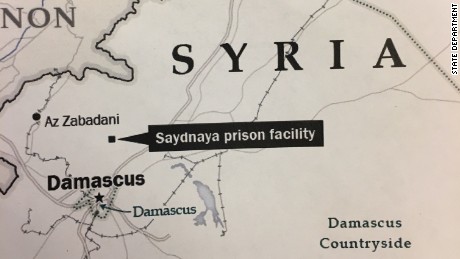
Jones said the regime could be killing as many as 50 detainees a day at Saydnaya. In February, Amnesty International alleged that thousands of people have been hanged at the Syrian prison just 45 minutes outside the capital of Damascus in a secret crackdown on dissent.
The "photos underscore the depths to which the Syrian regime has gone with the support of ... Russia," Jones said. He wouldn't confirm whether the US will take military action in response to the grisly discovery of the crematorium.
"We're not going to signal what we're going to do and what we're not going to do," Jones said, but he added that the US would "bring evidence forward to the international community."
"The Russian government and Minister Lavrov have indicated to us that they're interested in finding a solution," Jones said, adding that "there is no solution without an end to these atrocities."
State Department spokeswoman Heather Nauert said Tillerson "was firm and clear with Minister Lavrov that Russia holds tremendous influence with Bashar al-Assad" and must act to rein him in.
"Simply put, the killing and devastation has gone on for far too long in Syria," Nauert said.
Nauert said "both men agreed the way to bring stability to Syria" is through diplomacy, a lasting cease-fire that brings a reduction in violence and ensures humanitarian access, steps that "will help create political conditions on the ground for lasting solution to the conflict."
Since it began in 2011, Syria's civil war has claimed more than 400,000 lives, many of them civilians, Jones said. The regime's track record of torture, sexual violence, air strikes, artillery strikes, barrel bomb, and improvised unguided bombs or air-dropped IEDs, as well as the denial of food, water and medical care, have all been well documented, Jones said.
The Syrian regime has also systematically targeted eastern Aleppo's hospitals and made a practice of abducting civilians, Jones said. He said that between 2011 and 2015, the regime has abducted between 65,000 and 117,000 people.
Jones said the regime has also authorized the extra judicial killings of thousands of detainees at Saydnaya, which is a 45-minute drive outside of Damascus. It is just one of many detention facilities where prisoners are being held, Jones said.
The "continued brutality of the Assad regime" including its use of chemical weapons, represents a continued threat to regional stability and to the United States, Jones said. Given these abuses, "Russia must now with greater urgency exercise its influence," Jones said.
Jones said that despite the talks last week between Tillerson and Lavrov, he "would not say they have mapped a way forward on how to address Syrian atrocities or how to move forward on the Geneva process," which is meant to help establish a political settlement to the conflict.
He said the US has not shown Moscow the photos of the crematorium, but that they have "an ongoing conversation with the Russians" about their failure to condemn Syrian atrocities and the climate of tolerance that creates.

Comments