Opposition seeks changes from government, including independent judiciary
Viktor Orbán’s rightwing government in Hungary has faced a rare and sustained bout of protest in the capital, Budapest, culminating in a group of opposition MPs spending Sunday night at the state television headquarters, demanding airtime to make a series of demands of the government.
In the early hours of Monday, the MP Ákos Hadházy was forcibly removed from the premises by a group of security guards, but other MPs and MEPs inside the building refused to leave, having spent the night in a makeup room.
They were joined by more MPs on Monday morning, who jumped a fence to get into the building after being turned away at the main entrance. István Ujhelyi, an MEP for the opposition socialist party, tweeted: “Will not back down until we can read the demands of protesters. Some pushing around with security.”
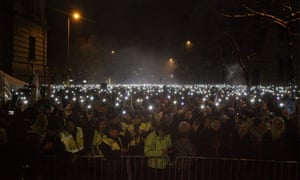
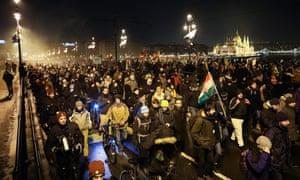
On Sunday, up to 15,000 people marched through Budapest, ignoring subzero temperatures to register their discontent with the government in the fourth such gathering since protests began on Wednesday. Police have used pepper spray against demonstrators in a number of tense standoffs.
A new protest has been called for Monday evening outside the television headquarters. “It’s clear that we will need to wait here until then,” said MP Bence Tordai by telephone from inside the building. He said he had got in by climbing over a fence on Monday morning and that the next step would be for representatives of different opposition parties to meet and agree on a new strategy of resistance to Orbán’s government.
Protesters outside parliament on Sunday listened to speeches from opposition figures before a smaller group walked several miles to the state TV headquarters.
The trigger for the protests was a piece of legislation labelled “slave law”, passed last Wednesday in parliament, that allows employers to increase the amount of overtime they can ask employees to work, but the mood is fuelled by a general malaise at the state of politics in Hungary.
The list of five demands MPs wanted to read out on television included a repeal of the “slave law”, an independent judiciary and independent public media.
On Wednesday, opposition MPs whistled, jeered and sounded sirens in parliament, in an ultimately unsuccessful attempt to block the passing of the law, as well as another piece of legislation that will increase governmental control of the court system.
“Over the last eight years there have been a lot of similarly mind-blowing bills passed through parliament, but this ‘slavery law’ naturally creates a sense of solidarity because it can affect almost every Hungarian citizen,” said Tordai.
Orbán’s Fidesz party has a two-thirds majority in parliament and widespread support across the country. Since coming to power in 2010, the government has wrested control of a number of previously independent institutions, and most local and media outlets are controlled by government-allied figures. The European parliament earlier this year voted to bring disciplinary proceedings against Hungary over rule-of-law issues.
As MPs camped out in the state television building, the channel made no reference to their presence, continuing with its usual output of news stories about migration, and suggesting that “pro-migration forces” were currently whipping up protests across Europe.
Orbán’s government has taken a populist, nativist line on immigration, portraying it as fighting powerful and “shadowy” pro-migration forces led by the Hungarian-born financier and philanthropist George Soros.
Government figures dismissed the protesters as insignificant in numbers, and with Christmas approaching it was unclear whether the movement would gain momentum or peter out.
So far, Orbán and his government have proved defiant, with the parliament speaker, László Kövér, criticising the opposition’s actions in parliament as “unprecedented in 28 years of Hungarian democracy”. Government-linked media have claimed the protests were organised by Soros.
Comments