Through all the rhetoric and saber-rattling however, it can be difficult to answer what should be a simple question:
North Korea is a nuclear-armed state with a wide-ranging missile program capable of medium to long-range strikes. It also possesses a large arsenal of conventional, chemical and biological weapons.
The number of missiles paraded in Pyongyang this week was "something of a scale we've never seen before," said David Schmerler, a research associate at the James Martin Center for Nonproliferation Studies.
The "vast number" of solid-fuel missiles on display was "most likely intended to drive home the point that (North Korea) has achieved the technical capability to produce longer-range solid-fuel missiles," he said.
Such weapons can be stored ready for launch for longer periods of time and require less preparation, making a surprise attack easier.

A series of solid-fuel missiles were on display at North Korea's most recent military parade.
"The number of tests, range and sophistication have gone up exponentially under Kim Jong Un," Euan Graham, an analyst at the Lowy Institute in Sydney, told CNN last month.
The North Koreans "have a fixed set of aims and ambitions, they want a nuclear weapon that's attached to a ballistic missile system," said Nick Bisley, an analyst at Melbourne's La Trobe University.

North Korea has tested numerous ballistic missiles in recent months, including submarine-launched missiles.
North Korea is one of only six countries not to have signed or acceded to the Chemical Weapons Convention and both the US and South Korea have said it possesses large stockpiles of chemical and biological weapons.
A 2012 report by the US Department of Defense warned those weapons could be deployed "by modifying a variety of conventional munitions, including artillery and ballistic missiles."
Despite widespread predictions of instability, Kim Jong Un has succeeded in maintaining his family's ironclad grip on the country, and fulfilled his father's desire of a functioning nuclear weapons program, as well as majorly improved missile capabilities.
International sanctions -- even with the buy in of China, North Korea's only real ally -- have failed to halt either of these programs. Right now, Graham said, Kim is focused on shoring up his long-term security, particularly against any threat of US-led regime change.
"They have no interest in talking, they're interested in locking in their gains," he said. "The hatches are down, economically Kim Jong Un has already priced in extra sanctions."
Joe Bermudez, an analyst with 38 North, said North Korea "believes the only way to deter the US from attacking them, and maintaining the power of the Kim regime is by the possession of nuclear weapons."
"They've repeatedly stated that if Libya or Iraq had nuclear weapons the US would not have attacked them," he said.
Some argue that the threat from North Korea hasn't changed, but what has changed is attitudes in Washington and Tokyo.
Jean Lee, a global fellow at the US-based Wilson Center, said that many South Koreans, who are most at risk of any conflict with North Korea, are less concerned with the rhetoric coming from Pyongyang as that coming from Washington.
"We know the North Koreans are going to push things to the edge, they always do, we don't know how President Trump will respond," she told CNN.
"The rhetoric and aggressive tone in the region right now feeds (Kim Jong Un's) resolve to continue developing and building nuclear missiles."

How Kim Jong Un and Donald Trump will act remains incredibly hard to predict.
Particularly prone to failure is the intermediate-range Musudan missile, believed to be the country's most domestically-developed and therefore easiest to build.
Tal Inbar, an analyst with the Fisher Institute for Air and Space Strategic Studies, said a reasonable amount of flight tests for an ICBM "would be at least six to eight successful launches." So far North Korea hasn't conducted one.
"The question remains of what would be the reliability of a missile that has never flown before," he said.
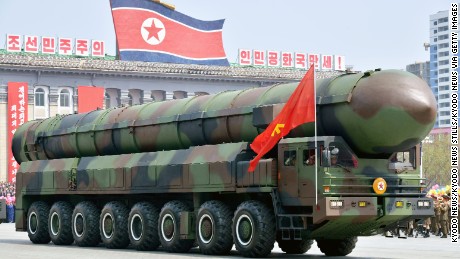
Two new purported ICBMs were on display at the recent military parade, raising questions as to the breadth of the North Korean program.
Claims about intercontinental capabilities should therefore be taken with a large grain of salt, said weapons expert Markus Schiller.
He said that while North Korean propaganda "looks impressive," it is also often wildly misleading. In particular, he points to the vast number of ICBMs Pyongyang claims are under development.
"They want to send a message that they have an ICBM, that they are dangerous," he told CNN, whereas in fact "they are a very, very long way away from this."
Parts of South Korea and Japan have been in range of conventional artillery or medium-range ballistic missiles for decades.
Chemical, biological and nuclear warheads give an extra, terrifying edge to this threat, but they too are a known threat and one that has not obviously increased in recent years.
"The threat has not changed," said Schiller. "They have always been a threat within the region, they're just trying to show the world they are dangerous (as well)."
Comments